

Community Plastics Recycling and Manufacturing Plant
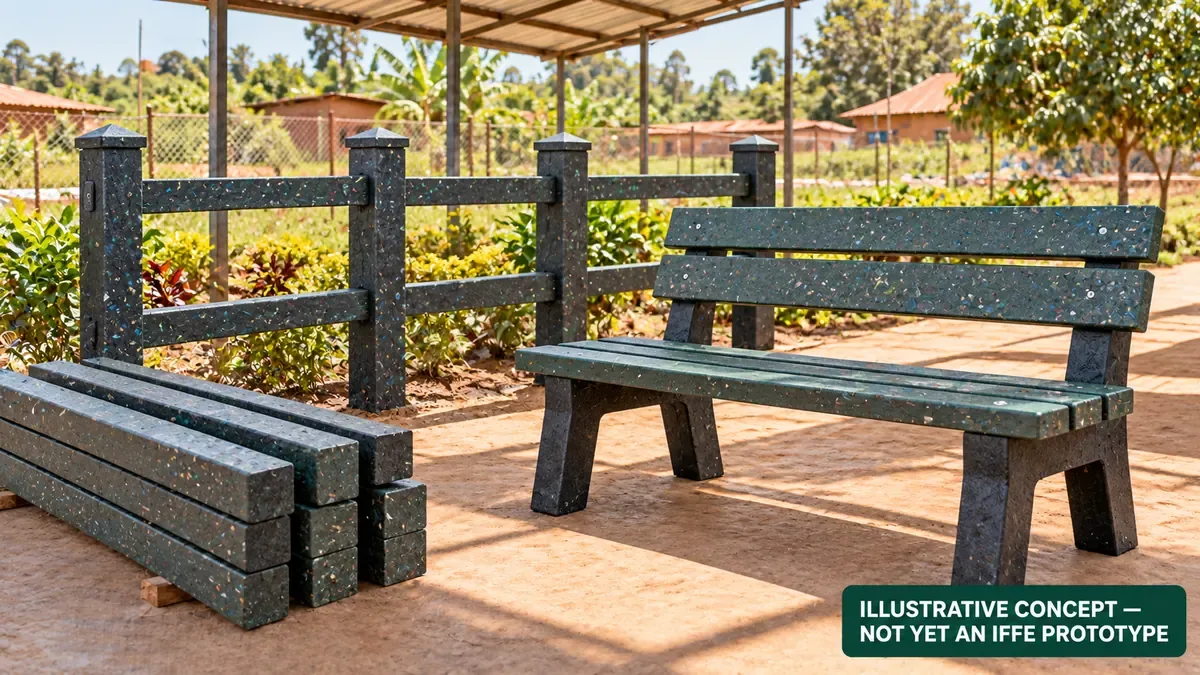
The long-term destination of Green Futures: a compliant plant converting recovered plastic into fence poles, benches, wall cladding and boards, creating local jobs. Not yet approved or built.
Project overview
The long-term destination of Green Futures: a compliant plant converting recovered plastic into fence poles, benches, wall cladding and boards, creating local jobs. Not yet approved or built.
Background
Set out in the Green Futures concept note and 36-month roadmap (September 2026). The plant proceeds only through six stage gates, so that supply, demand, safety and governance are proven before any machinery is bought.
Problem being addressed
Recovered plastic has little local value without processing, and Iganga lacks the manufacturing jobs that could turn it into useful products.
Objectives
- Prove feedstock supply and customer demand
- Select a safe, suitable technology and product mix through feasibility studies
- Secure every environmental, planning, workplace-safety and product-standard approval
- Create safe, fairly paid adult jobs and supplier income
- Run with earned-income discipline and a maintenance reserve
Activities
- Feedstock study: polymer types, tonnes per month, contamination, prices, collection radius
- Market study: buyers, competing products, willingness to pay
- Technical and site feasibility, environmental review and five-year financial model
- Prototype testing for strength, weathering and finish with a technical partner
- Staged funding: feasibility, then approvals and equipment, then commissioning
Stage gates
- Stage 1: Evidence
Gate: verified baseline and partner letters (in progress) - Stage 2: Feasibility
Gate: Board-approved feasibility report - Stage 3: Prototype
Gate: test reports, costed prototypes, purchase interest - Stage 4: Capital
Gate: investment-grade proposal and due diligence file - Stage 5: Build
Gate: licensed and commissioned facility - Stage 6: Scale
Gate: audited performance and reinvestment plan
Target products
| Product | Potential market | Validation before sale |
|---|---|---|
| Fence poles | Farms, institutions, property owners | Strength, dimensions, fastening, weathering, installation |
| Benches | Schools, churches, parks, businesses, homes | Load capacity, stability, finish, outdoor durability |
| Wall cladding | Residential, commercial, institutional projects | Fire behaviour, weathering, fixing, dimensional stability |
| Boards and profiles | Fabricators, furniture makers, builders | Machinability, consistency, approved end uses |
Products will be sold only after testing and the certification route advised by UNBS.
Impact indicators
| Indicator | Baseline | Target | Actual |
|---|---|---|---|
| Households, students and adults reached | [Baseline] | [Target] | [To be reported] |
| Tonnes of plastic by type sourced, rejected and traceably transferred | [Baseline] | [Target] | [To be reported] |
| Clean-ups completed and sites maintained after three months | [Baseline] | [Target] | [To be reported] |
| Prototype and production units passing quality checks | [Baseline] | [Target] | [To be reported] |
| Adults trained, jobs created, supplier income, worker safety | [Baseline] | [Target] | [To be reported] |
| Sales, margin and production cost (plant stage) | [Baseline] | [Target] | [To be reported] |
Project updates
[Updates will be posted once implementation begins]
Photo gallery
Adults, activities and places. No identifiable children.
Adults, activities and places. No identifiable children.
Adults, activities and places. No identifiable children.
Related stories
[Consented stories to be added]